
Captain William Piatt
Captain William Piatt was born in New Jersey in 1745, the son of a family with deep roots in the struggle for religious liberty. His grandfather was a French Huguenot who fled persecution in France, eventually making his way to America and settling in New Jersey - a heritage of sacrifice that seemed to run in the family's blood. Piatt and all four of his brothers served in the American Revolution, a remarkable testament to their commitment to the Patriot cause. He began his own service in December 1775 as a Private and Sergeant in the First New Jersey Regiment, rising steadily through the ranks, commissioned 2nd Lieutenant in August 1776, promoted to 1st Lieutenant in January 1777, and elevated to Captain on March 11, 1780. He served in General George Washington's Body Guard and continued in service until his honorable discharge in April 1783. He was a founding member of the New Jersey Society of the Cincinnati, the brotherhood of Revolutionary War officers.
After the war, Piatt returned home to Scotch Plains, New Jersey, where he and his wife Sarah Shotwell Piatt raised their family. By his own family's account, the post-war years were difficult. Piatt came home poor, his health diminished, his prospects uncertain, as was the fate of so many veterans of the long and costly war. Yet when the young nation called again in 1791, Piatt answered. He was reappointed as a Captain in the New Jersey Battalion of the Second Regiment of Levies on April 4, 1791, recruited his company in New Brunswick and the surrounding area of southern New Jersey, and then marched on foot from New Jersey all the way to Cincinnati, Ohio, traveling via Pittsburgh, Pennsylvania, to join General Arthur St. Clair's expedition into the Northwest Territory.
Piatt served throughout the entire Northwest Territory military campaign of 1791. On the morning of November 4, when the Native American confederacy launched its devastating dawn attack on the encampment along the Wabash River, he fought with the same resolve he had shown throughout his long career of service. In the chaos of the retreat, he was found by friends sitting wounded against a tree. They offered to help carry him to safety. He refused, telling them to leave him and save themselves, as he was too badly hurt for them to escape while carrying him. They left him, and he died where he sat. His remains are buried in one of the mass graves beneath the monument at Fort Recovery, Ohio. His widow Sarah lived to the age of 95, drawing a pension from the United States government for many years in recognition of her husband's sacrifice.
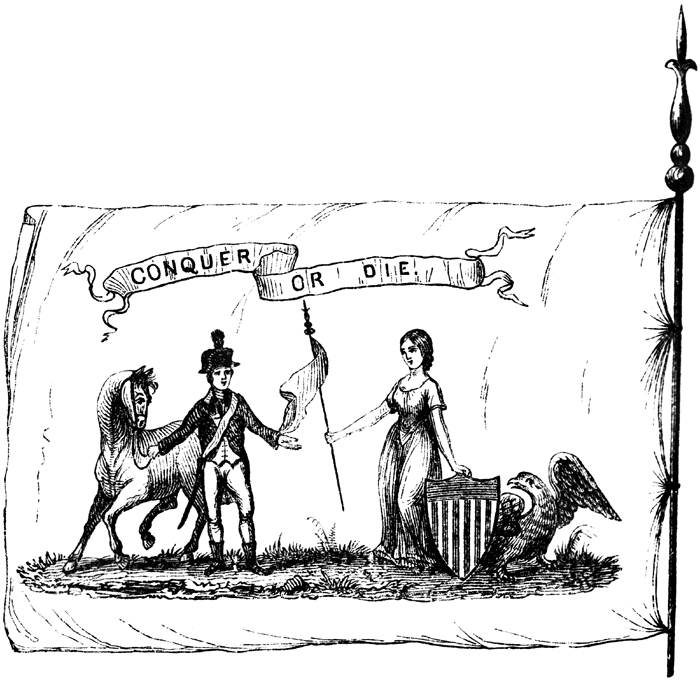
Benson John Lossing (1813–1891), "Banner of Washington's Commander-in-Chief's Guard." Wood engraving from The Pictorial Field-Book of the Revolution, Vol. 2. New York: Harper & Brothers, 1852. Public domain. The Commander-in-Chief's Guard - commonly known as Washington's Life Guard - was the elite unit charged with protecting General George Washington throughout the Revolutionary War. Captain William Piatt was among its members, one of five brothers from New Jersey who served the Patriot cause.
Sources
Lossing, Benson John. The Pictorial Field-Book of the Revolution. Vol. 2. New York: Harper & Brothers, 1852. Public domain. Wikimedia Commons. https://commons.wikimedia.org/wiki/File:Washington%27s_Life_Guard.png.

Lytle, Richard M. The Soldiers of America's First Army, 1791. Lanham, Maryland: Scarecrow Press, 2004.
"William Piatt." Society of the Cincinnati in the State of New Jersey. https://njcincinnati.org/william-piatt/.
"History of Piatt Family." Griggs County Historical Society. https://griggscountyhistoricalsociety.com/online/porterville/box02/box02folder15.php.
"Capt. William Piatt (1743–1791)." FindAGrave Memorial No. 64996773. https://www.findagrave.com/memorial/64996773/william-piatt.