
Major William Ferguson, Commandant
Major William Ferguson was born in Armagh, Ireland, the son of Usher and Mary Ferguson. The date of his immigration to America is not recorded, but by October 1776 he had joined the Pennsylvania Committee of Safety's artillery regiment, receiving his first commission as 3rd Lieutenant under Colonel Thomas Proctor. By March 14, 1777, he had risen to captain-lieutenant of what would become the 4th Continental Artillery Regiment, a corps that fought at Trenton, Princeton, Brandywine, and Germantown, and participated in General Sullivan's 1779 expedition against the Six Nations, where Ferguson likely gained his first experience fighting Native Americans.
Less than a month after his March 1777 promotion, he was captured by the British on April 13 at Bound Brook, New Jersey, and held prisoner at Flatbush, Long Island. Even in captivity, his abilities were recognized: he was promoted to the rank of Captain on April 14, 1778, one year and one day after his capture. He was exchanged on December 1, 1780, returned to duty, and was discharged on January 1, 1783. At the close of the war, Ferguson became an original member of the Society of the Cincinnati.
After the Revolution, the government refused to release Ferguson from service, particularly given the growing threat on the western frontier. He was appointed Captain of the U.S. Artillery in October 1785 and Captain of the Artillery Battalion in September 1789. During these years he commanded Fort McIntosh, helped construct Fort Washington (modern-day Cincinnati) and served along the frontier line of forts in the Northwest Territory. General Harmar, under whom Ferguson served for years, wrote in 1788 that Ferguson was "an officer of distinguished and superior abilities in the Artillery department," doubting whether his equal "can be furnished by any State in the Union." Ferguson commanded the artillery at Harmar's Defeat in 1790, and on March 4, 1791, was promoted to Major and Commandant of the U.S. Artillery Battalion, serving as the chief engineering officer of the United States Army for the 1791 campaign.
On the night of November 3, 1791, Major Ferguson and General St. Clair were together at the Wabash River encampment, planning a defense they would never have the chance to execute. At dawn on November 4, an overwhelming force of Native warriors struck. Ferguson's artillery pieces were captured and recaptured three times before being lost; every artillery officer but one was killed, that one desperately wounded, and every horse belonging to the regiment was killed. Major Ferguson was among the fallen. General St. Clair wrote in his official report that the loss of "Gen. Butler and Major Ferguson cannot be too much regretted," noting that all fell "most gallantly doing their duty." His remains are buried in the mass grave beneath the battlefield monument at Fort Recovery, Ohio.
Sources
Alexander, S. D. "Major William Ferguson." American Historical Record 2, no. 17 (May 1873): 217–220.
Lytle, Richard M. The Soldiers of America's First Army, 1791. Lanham, Maryland: Scarecrow Press, 2004.
"George Washington to Owen Biddle, 14 April 1777." Founders Online. National Archives. https://founders.archives.gov/documents/Washington/03-09-02-0150.
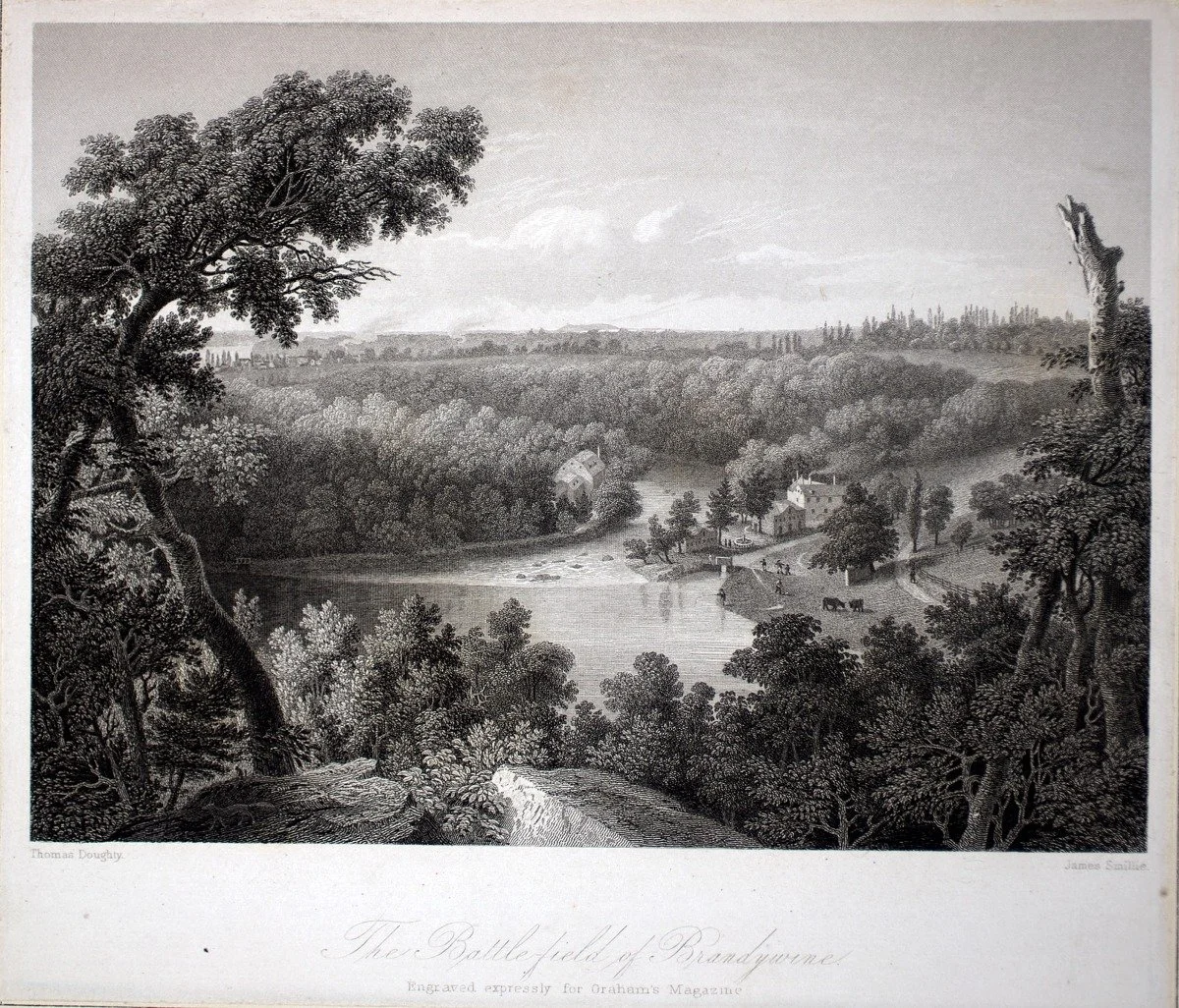
James Smillie, Thomas Doughty, The Battlefield of Brandywine, engraving, Smithsonian American Art Museum, Gift of Olin Dows, 1978.152.89