
Lieutenant William Boyd
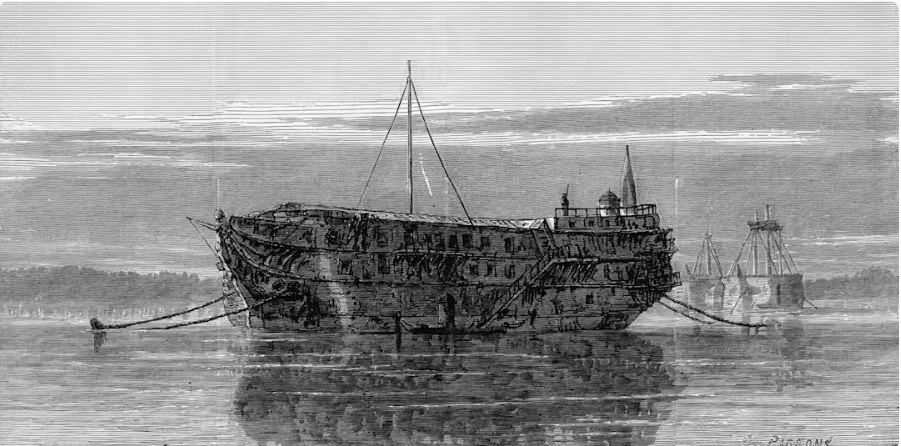
Charles Parsons (1821–1910), "The British Hospital Ships - the 'Jersey' in the Foreground." New York Public Library Digital Collections. The HMS Jersey, anchored in Wallabout Bay off the coast of Brooklyn, New York, was the most notorious British prison ship of the Revolutionary War. Historians estimate that approximately 11,000 Americans died aboard British prison ships during the course of the war. An unnamed brother of Lieutenant William Boyd was among those who perished in New York Harbor - one of the Revolution's most overlooked tragedies.
Lieutenant William Boyd was born in Maryland, the son of William Boyd Sr. and Charity Talbot. His father was a Scotch Episcopalian who had settled in Washington County, Maryland, along the old Braddock Road near the Potomac River, and his mother was a descendant of George Talbot, a cousin to Lord Baltimore, connecting the Boyd family to one of Maryland's most prominent colonial dynasties. William Sr. was described by family historians as "a man of high spirits and sense of honor," who transmitted to his children "many independent characteristics." All of his sons served the Patriot cause during the Revolutionary War. One brother perished on a British prison ship in New York Harbor - one of the thousands of Americans who died in those wretched vessels during the Revolution. Another brother, Walter Boyd, served as a Lieutenant in the Continental Army and commanded Fort Frederick, a frontier post on the Potomac River between Williamsport and Hancock, Maryland. William himself served in the Maryland Militia during the Revolutionary War before his commission as a Lieutenant in the years that followed.
By 1791, William Boyd was living in Virginia and was commissioned as a Lieutenant in the Virginia Battalion under Captain Lewis, as part of the 1st Regiment of Levies under Lieutenant Colonel William Darke. He joined General Arthur St. Clair's expedition into the Northwest Territory, a campaign plagued from the outset by poor training, inadequate supplies, and relentless desertions. The army that marched north from Fort Washington in the fall of 1791 was, by nearly every account, dangerously unprepared for what awaited it on the banks of the Wabash River.
On the morning of November 4, 1791, the Native American confederacy led by Little Turtle and Blue Jacket launched their devastating dawn attack on St. Clair's encampment. Lieutenant William Boyd was killed in the action, one of 39 officers who fell that day out of 52 engaged. A family history written nearly a century later recorded simply that he "survived and died - a Lieutenant in St. Clair's defeat after the war." He is buried in the mass grave beneath the battlefield monument at the center of Fort Recovery, Ohio, alongside so many of the men honored on this memorial.
Sources:
Boyd, William P. History of the Boyd Family and Its Descendants. Rochester, N.Y.: John P. Smith Printing Company, 1912, pp. 129, 153.
Maryland Pensioners of the American Revolution. Maryland State Archives.
Lytle, Richard M. The Soldiers of America's First Army, 1791. Lanham, Maryland: Scarecrow Press, 2004.
Parsons, Charles. The British Hospital Ships — the 'Jersey' in the Foreground. New York Public Library Digital Collections, accession no. EM11340. Public domain. https://digitalcollections.nypl.org/items/510d47e0-c72d-a3d9-e040-e00a18064a99.
St. Clair's Defeat. Public Library of Fort Wayne and Allen County. Project Gutenberg. https://www.gutenberg.org/files/64870/64870-h/64870-h.htm.