
Captain Samuel Newman
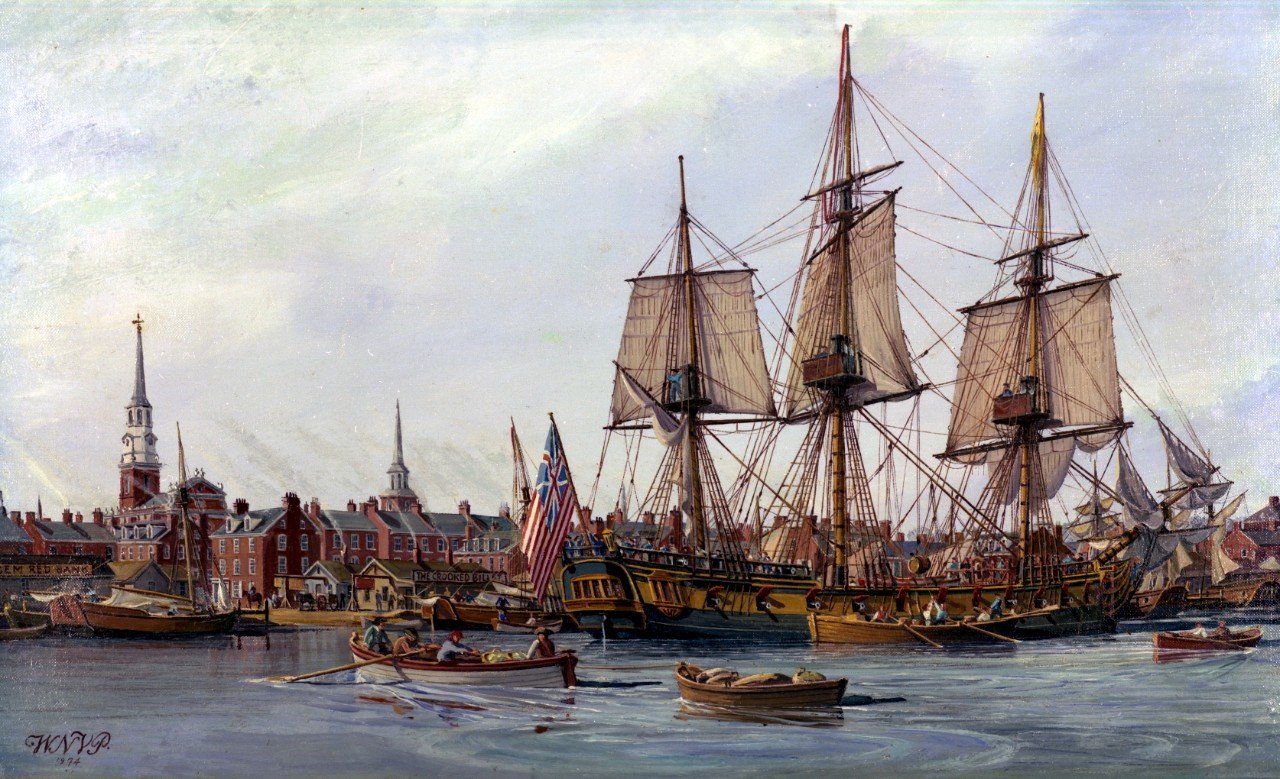
W. Nowland Van Powell, "Continental Ship Alfred at Philadelphia, 3 December 1775." Oil on canvas. U.S. Navy Art Collection, Washington, D.C. The Alfred was the flagship of Commodore Esek Hopkins' Continental Navy squadron and one of the first ships of America's fledgling navy. Lieutenant Samuel Newman served as a gunnery officer in the Continental Navy from 1778 to 1783 — an unusual distinction that set him apart from nearly every other officer buried at Fort Recovery.
Lieutenant Samuel Newman was born in Boston, Massachusetts in 1758. He entered the Revolutionary War in 1776 as an Ensign in Captain Joseph Balch's Company of Colonel Craft's Continental Artillery Regiment, participating in the Siege of Boston and operations on Lake Champlain and Fort Ticonderoga. Upon the disbandment of Craft's artillery regiment, he was promoted to Lieutenant in Lee's Additional Continental Infantry Regiment on May 20, 1777, where he was active in recruiting and organizing a regiment composed of volunteers from Essex, Middlesex, Suffolk, and Bristol counties of Massachusetts. That October, his regiment joined the main Continental Army at Valley Forge, and in the spring and summer of 1778 it covered the British withdrawal from Philadelphia and fought at the Battle of Monmouth Courthouse. He was then reassigned to the Eastern Department and participated in operations associated with the failed defense of Newport, Rhode Island. In December 1778, Newman resigned his commission from the Continental Army and obtained a commission as a gunnery officer in the Continental Navy, serving in that capacity until his discharge in 1783.
On March 4, 1791, Newman was appointed from Massachusetts as senior Lieutenant in the Second United States Regiment of Infantry. Some records, including Lytle's The Soldiers of America's First Army and the official casualty list, suggest he may have received a promotion to Captain on March 18, 1791, after another officer refused the position. However, Ebenezer Denny, a fellow officer present at St. Clair's Defeat who kept a detailed firsthand journal of the campaign, recorded Newman as a Lieutenant. It is possible the promotion was not universally recognized in the field, recorded inconsistently across sources, or that it was a circumstantial appointment that some contemporaries did not acknowledge. This memorial honors Newman at the rank of Lieutenant, consistent with Denny's eyewitness account, while acknowledging the historical record on this point is not fully settled.
In April 1791, Newman established recruiting offices in Springfield, Massachusetts, and at Pollsey's Tavern in Northampton, drawing enlistments from across the Connecticut River valley. By July 1, his company was complete, and he marched his soldiers to Middletown, Connecticut, where they boarded ships to Perth Amboy, New Jersey, then marched to Brunswick Barracks. After a month in Brunswick, Philadelphia, and Carlisle, Pennsylvania, he and his company departed westward for Fort Pitt as escort for ammunition and specialized equipment destined for St. Clair's expedition. They arrived at Fort Pitt on August 28 and the next day began the riverboat journey down the Ohio River to Fort Washington - traveling in the company of Major General Richard Butler himself. Newman reached Fort Washington on September 10, 1791, and joined the First Battalion of the Second Regiment of Infantry, commanded by his fellow Mercer County memorial honoree Major Jonathan Heart.
On November 4, 1791, during the devastating dawn attack by the Native American confederacy, Newman was seriously wounded in the arm. As the shattered remnants of the army began their desperate retreat, his surviving soldiers attempted to place him on the back of a horse to carry him to safety. Before they could escape, he was shot again and killed instantly. He rests in one of the mass graves beneath the battlefield monument at the center of Fort Recovery, Ohio. He left behind a journal of his service with the First United States Army, a firsthand account published in 1918 that remains a valuable historical record of the men and events surrounding St. Clair's campaign.
Sources
Lytle, Richard M. The Soldiers of America's First Army, 1791. Lanham, Maryland: Scarecrow Press, 2004.
Quaife, Milo M. "A Picture of the First United States Army: The Journal of Captain Samuel Newman." Wisconsin Magazine of History 2, no. 1 (September 1918): 40–43.
Denny, Ebenezer. Military Journal of Major Ebenezer Denny. Philadelphia: J. B. Lippincott & Co., 1859.
St. Clair's Defeat. Public Library of Fort Wayne and Allen County. Project Gutenberg. https://www.gutenberg.org/files/64870/64870-h/64870-h.htm.
Van Powell, W. Nowland. Continental Ship Alfred at Philadelphia, 3 December 1775. Oil on canvas. U.S. Navy Art Collection, Washington, D.C. Naval History and Heritage Command Photograph NH 85212-KN. Public domain. https://www.history.navy.mil/our-collections/photography/numerical-list-of-images/nhhc-series/nh-series/NH-85000/NH-85212-KN.html.