
Captain Robert Henry Kirkwood
“No man deserves better of his country than Captain Kirkwood.”
- General Nathanael Greene
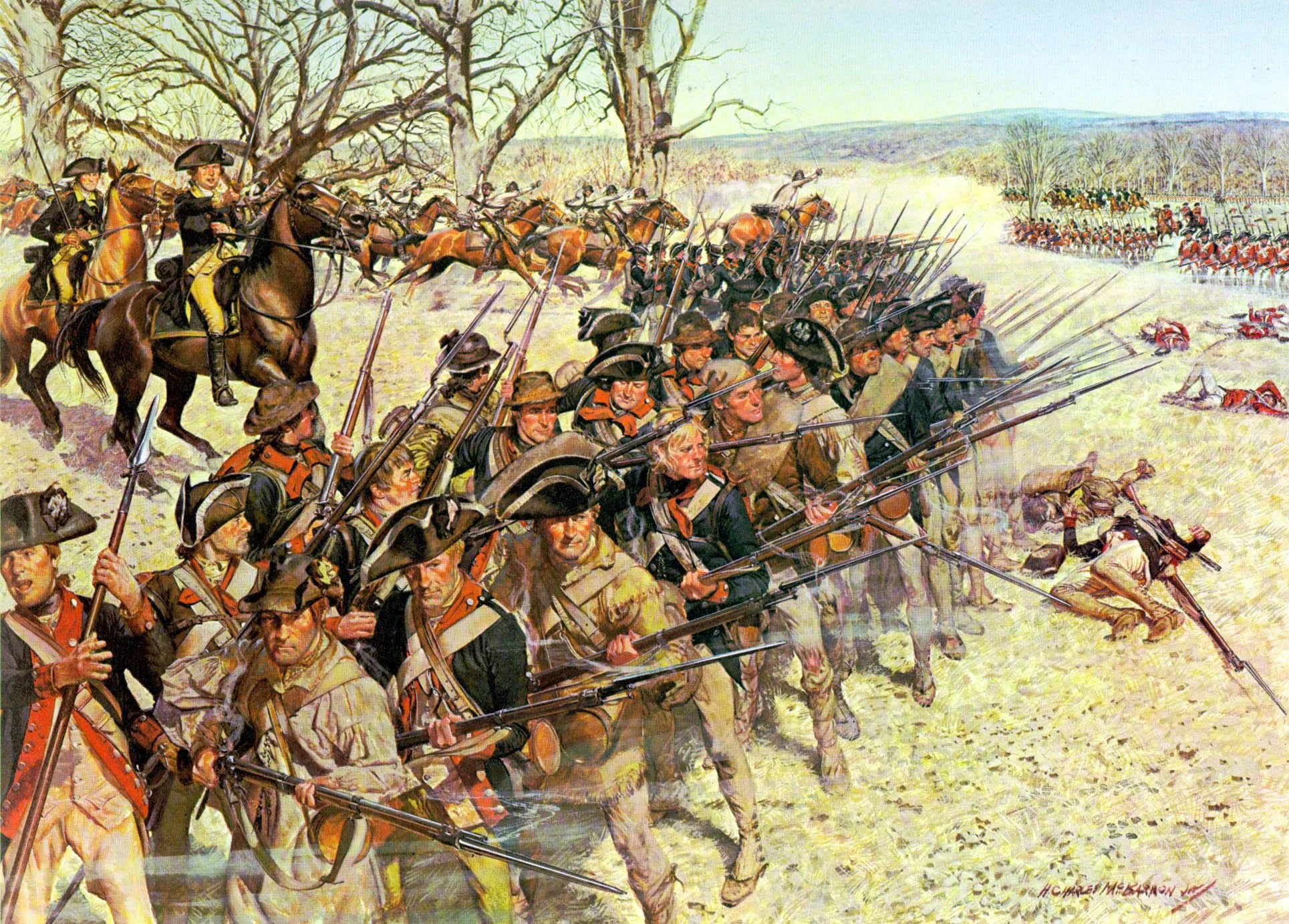
The Battle of Guilford Courthouse, March 15, 1781 (Public Domain)
Captain Robert Kirkwood was born in 1756 near Newark, Delaware, the only son of an Irish immigrant family. He grew up on the family farm on Polly Drummond Hill and attended Newark Academy with ambitions of becoming a minister until the Revolutionary War changed everything. He joined the Delaware Regiment in January 1776 and quickly distinguished himself under fire. At this time, he also began writing his meticulous journals of troop movements and battles that historians still rely on today.
What followed was one of the most extraordinary combat records of the entire war. Kirkwood fought in battle after battle across both the northern and southern theaters - Long Island, Brandywine, Germantown, Monmouth, Camden, Cowpens, and Guilford Courthouse among them - accumulating 32 engagements without suffering a significant wound. At the Battle of Camden, his company won fame for its determined stand against the British, with the Delaware Regiment suffering heavy losses. The 1st Delaware Regiment performed so admirably at Camden that General Nathanael Greene and others called them “The Delaware Blues,” named so for their fighting spirit that reflected that of the Blue Hen gamecock roosters that traveled from Delaware with the regiment!
At Cowpens, Kirkwood repulsed the British cavalry and made a famous bayonet charge ordered by Colonel John Eager Howard. In the final battles of the Revolution, including those at Guilford Courthouse and Eutaw Springs, Kirkwood repeatedly won the praise of General Greene, who acknowledged Kirkwood’s unit for its “judicious and alert behavior.” After the war, he returned to Delaware, married, and eventually moved west to Ohio following his wife's death, receiving a land grant in the Northwest Territory.
In 1791, Kirkwood was commissioned a Captain in the 2nd U.S. Infantry and joined General Arthur St. Clair's expedition into the Northwest Territory, his 33rd engagement. On the morning of November 4, a coalition of Native American tribes attacked the forces encamped on the banks of the Wabash River. Kirkwood was seen rallying his troops, but was soon shot in the abdomen. A fellow officer found him leaning against a tree and offered help, to which Kirkwood replied, "No, I am dying, save yourself if you can, and leave me to my fate." He was found scalped where he had fallen - a man who had survived the fiercest battles of the Revolution only to meet his end on the Ohio frontier. His body is interred beneath the Fort Recovery memorial commemorating the battle.
Sources
Turner, Joseph Brown, ed. The Journal and Order Book of Captain Robert Kirkwood of the Delaware Regiment of the Continental Line. Wilmington: The Historical Society of Delaware, 1910.
"Robert Kirkwood, Jr." Delaware Public Archives Historical Marker. Installed 2011. https://archives.delaware.gov/delaware-historical-markers/robert-kirkwood-jr/.
"Robert Kirkwood." American Battlefield Trust. https://www.battlefields.org/learn/biographies/robert-kirkwood.