
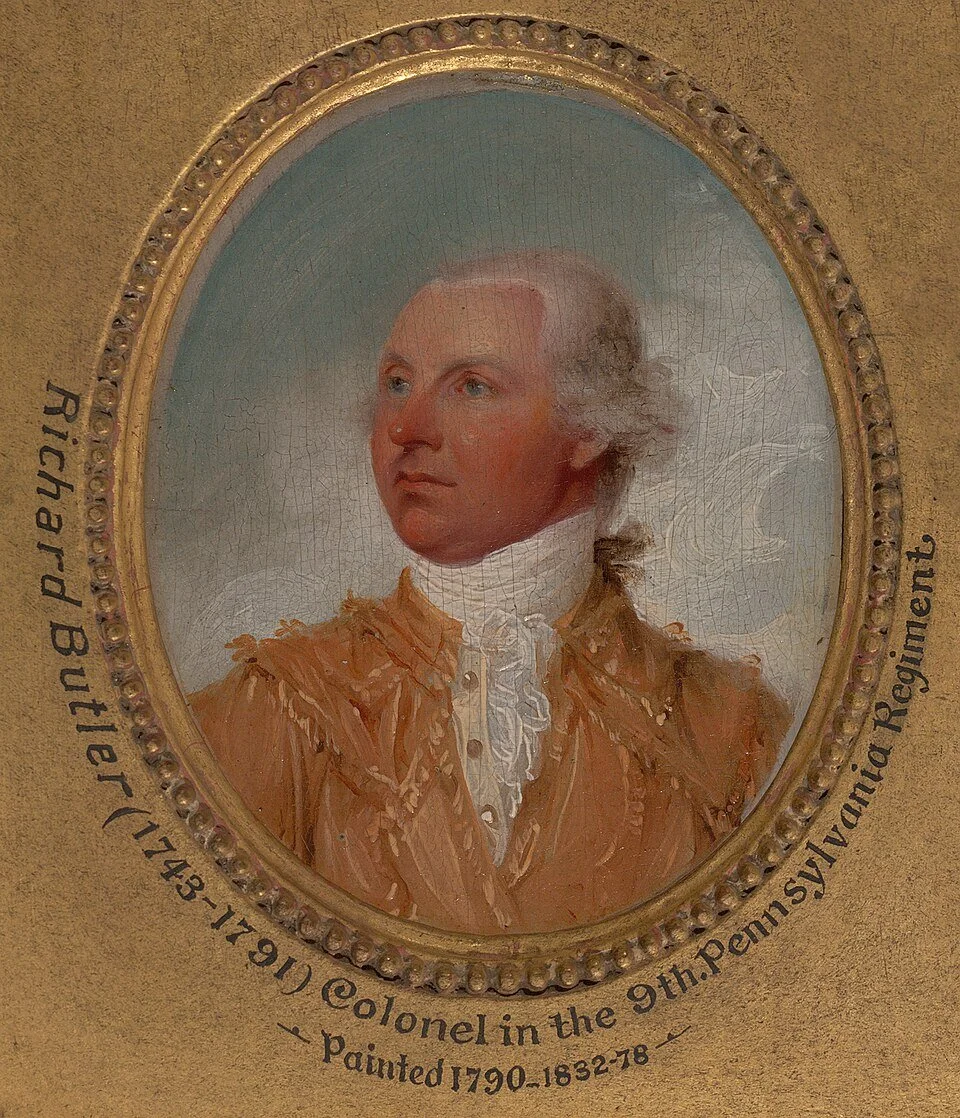
Major General Richard Butler
Source
Gratz, Simon. "Biography of General Richard Butler." Pennsylvania Magazine of History and Biography 7, no. 1 (1883): 7–10.
"Butler, Richard." In Encyclopedia of the American Revolution: Library of Military History, edited by Harold E. Selesky. New York: Charles Scribner's Sons, 2006. https://www.encyclopedia.com.
Williams, Edward G. "The Journal of Richard Butler, 1775." Western Pennsylvania Historical Magazine. https://journals.psu.edu/wph/article/download/1995/1843.
"George Washington to Richard Butler, 7 April 1791." Founders Online. National Archives. https://founders.archives.gov/documents/Washington/05-08-02-0052.
Pennsylvania Senate Library. "General Richard Butler." https://www.library.pasen.gov/people/member-biography?id=4416.
Major General Richard Butler was born on April 1, 1743, in Dublin, Ireland, the eldest son of Thomas and Eleanor Butler. In 1748, the family emigrated to Pennsylvania, eventually settling on the frontier at Carlisle, where they became gunsmiths and friends with the likes of Daniel Morgan. Richard and his brother William became prominent Indian traders at Fort Pitt and in Ohio, giving Butler a deep familiarity with Native peoples that would shape his entire career. He and his brothers would become legendary in the Revolution as "The Fighting Butlers," with all five sons serving in Washington's army.
When the Revolutionary War broke out, Butler rose swiftly through the ranks of the Pennsylvania Continental Line. He fought alongside Morgan's Riflemen at Saratoga and Monmouth, and served with Anthony Wayne at Stony Point. He was present at Yorktown as second in command when Cornwallis surrendered - the decisive victory that ended the war. After the war he was breveted Brigadier General, became a large landowner and judge in the Pittsburgh area, served in the Pennsylvania State Senate, and was appointed Superintendent of Indian Affairs, negotiating key boundary treaties with Native tribes in the Northwest Territory.
In 1791, Butler was commissioned a Major General and appointed second in command under General Arthur St. Clair in a federal expedition against the Western Confederacy of Native Americans in Ohio. On the morning of November 4, 1791, forces led by Chief Little Turtle launched a devastating ambush on St. Clair's encampment. Richard was shot twice, tomahawked and scalped. His brother Thomas was shot in both legs with his thigh broken, and he would not have survived had not the dying Richard insisted that his brother Edward save Thomas by retreating with the remnant of the army.
St. Clair’s Defeat remains one of the worst military defeats in American history, and Butler was buried on the battlefield, his grave lost for years before being rediscovered and reinterred at Fort Recovery, Ohio.