
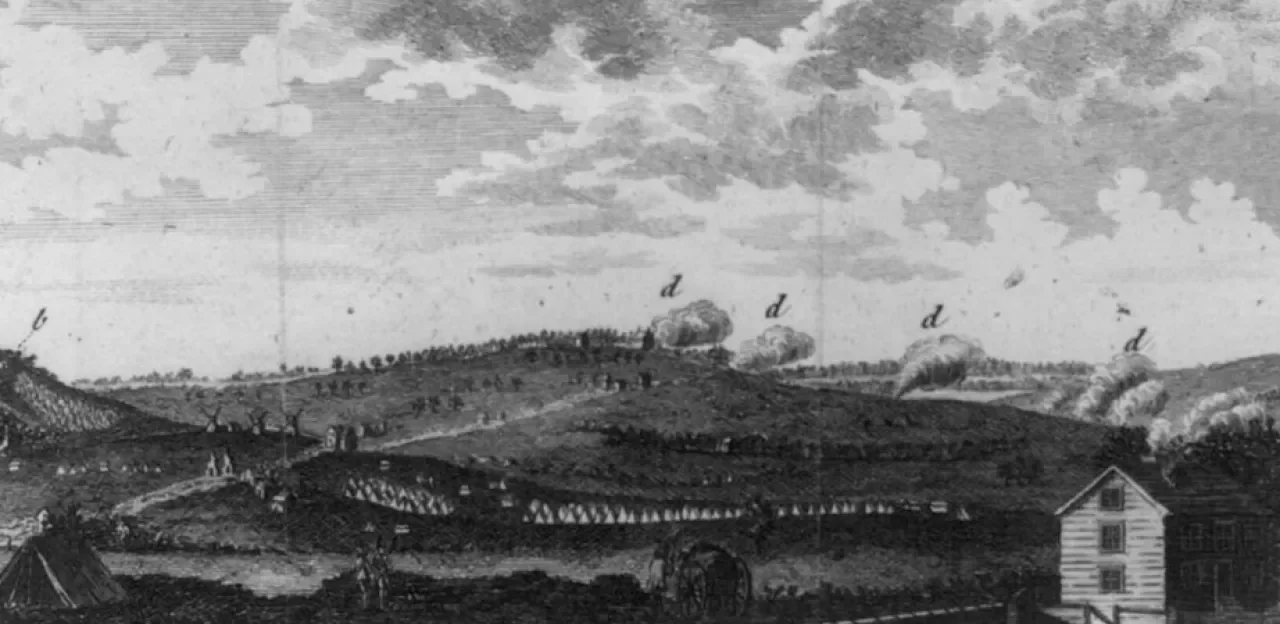
The Siege of Rhode Island, taken from Mr. Brindley's house on the 25th of August, 1778." Published in The Gentleman's Magazine*, London, 1779. This period engraving depicts the American siege of British-held Newport, Rhode Island, in August 1778 — the engagement in which Captain Patrick Phelan and the soldiers of Jackson's Additional Continental Regiment served with distinction.
Captain Patrick Phelan(also spelled Phelon) was born in Massachusetts in 1750. He entered the Revolutionary War on June 20, 1777, appointed as a 1st Lieutenant in Henley's Additional Continental Infantry Regiment, which had been organized from companies recruited in Suffolk and Middlesex counties. His unit was assigned to the Eastern Department before being ordered to join Washington's main army in March 1778. During the remainder of that year Phelan participated in the covering operations that shadowed the withdrawal of British troops from Philadelphia, fought at the Battle of Monmouth Courthouse, and served in the defense of Newport, Rhode Island. On April 22, 1779, he transferred to Jackson's Additional Continental Infantry Regiment, where he was involved in operations associated with the siege of New York City. He was subsequently reassigned to the 16th Massachusetts Infantry, then the 9th Massachusetts, and finally the 3rd Massachusetts Infantry, with each transfer reflecting the consolidations and reorganizations of a Continental Army fighting a long and exhausting war.
On September 30, 1783, Phelan was awarded the brevet rank of Captain. He was reassigned to Jackson's First American Regiment on November 3, 1783, serving as part of the garrison at West Point, New York, it being the last major Continental Army unit, until he was honorably discharged on June 20, 1784. He returned home to his wife Mary and daughters in Salem, Essex County, Massachusetts. On March 4, 1791, he was appointed Captain in the Second United States Regiment of Infantry and began recruiting his company from the Worcester and Boston areas. He completed recruiting by June 1, 1791, and commanded his company's march to Middletown, Connecticut, where they boarded ships bound for Perth Amboy, New Jersey, and then marched to Brunswick Barracks. He served as column commander of his seventy-man company on the journey to Fort Pitt, arriving there with his two-hundred-man column on August 7, 1791. On August 25, he departed Fort Pitt as part of a flotilla of twelve flatboats carrying 260 men, arriving at Fort Washington on September 10 to join St. Clair's Northwest Territory campaign.
On November 4, 1791, when the Native American confederacy launched its devastating dawn attack on the encampment along the Wabash River, Phelan fought alongside two men also buried here at Fort Recovery — Major Jonathan Heart and Captain Robert Kirkwood. When both Heart and Kirkwood fell during the action, Phelan took command of what remained of the 2nd United States Infantry. He too was killed shortly thereafter, leading a bayonet charge to remove enemy sharpshooters from in front of the artillery guns. He was buried in one of the mass graves beneath the battlefield monument at the center of Fort Recovery, Ohio.
Sources
Lytle, Richard M. The Soldiers of America's First Army, 1791. Lanham, Maryland: Scarecrow Press, 2004.
"Jackson's Regiment." Encyclopedia of the American Revolution: Library of Military History. Encyclopedia.com. https://www.encyclopedia.com/history/encyclopedias-almanacs-transcripts-and-maps/jacksons-regiment.
St. Clair's Defeat. Public Library of Fort Wayne and Allen County. Project Gutenberg. https://www.gutenberg.org/files/64870/64870-h/64870-h.htm.