
Lieutenant Edward Spear
Lieutenant Edward Spear was born in Pennsylvania in 1745. He began his military service as a Ranger in the 1st Regiment, a frontier unit tasked with defending Pennsylvania's western settlements against raids during the early years of the Revolutionary War. He received his formal commission as 2nd Lieutenant in the 6th Pennsylvania Regiment on February 7, 1778, joining a unit that had already distinguished itself in some of the war's most significant engagements. The 6th Pennsylvania had fought at Brandywine and Germantown in 1777, wintered at Valley Forge, and was present at the Battle of Monmouth in June 1778 - a battle Spear, having just received his commission, was very likely present for as well. The regiment went on to storm the British fortifications at Stony Point, New York, under General Anthony Wayne in July 1779.
Spear was promoted to 1st Lieutenant on May 16, 1781, and transferred to the 1st Pennsylvania Regiment on January 1, 1783, serving until November 3 of that year, the final day of the Continental Army's active service. Like many of his fellow officers, he did not return to civilian life for long. He was appointed Lieutenant in the U.S. Artillery Battalion on September 10, 1787, and reappointed Lieutenant of Artillery on September 29, 1789, as part of the first regular army organized under the new federal government. His long service, from frontier ranger to Continental officer to regular army lieutenant, reflected a rare and deep commitment to the defense of the young nation.
In 1791, Spear joined General Arthur St. Clair's campaign into the Northwest Territory. On the morning of November 4, 1791, the Native American confederacy launched their devastating surprise attack on the encampment along the Wabash River. Lieutenant Edward Spear was among the officers killed. He is listed by name on the official casualty roll of St. Clair's Defeat, one of 39 officers killed out of 52 engaged… a staggering loss that shocked the young nation. His remains are buried in the mass grave beneath the battlefield monument at Fort Recovery, Ohio.
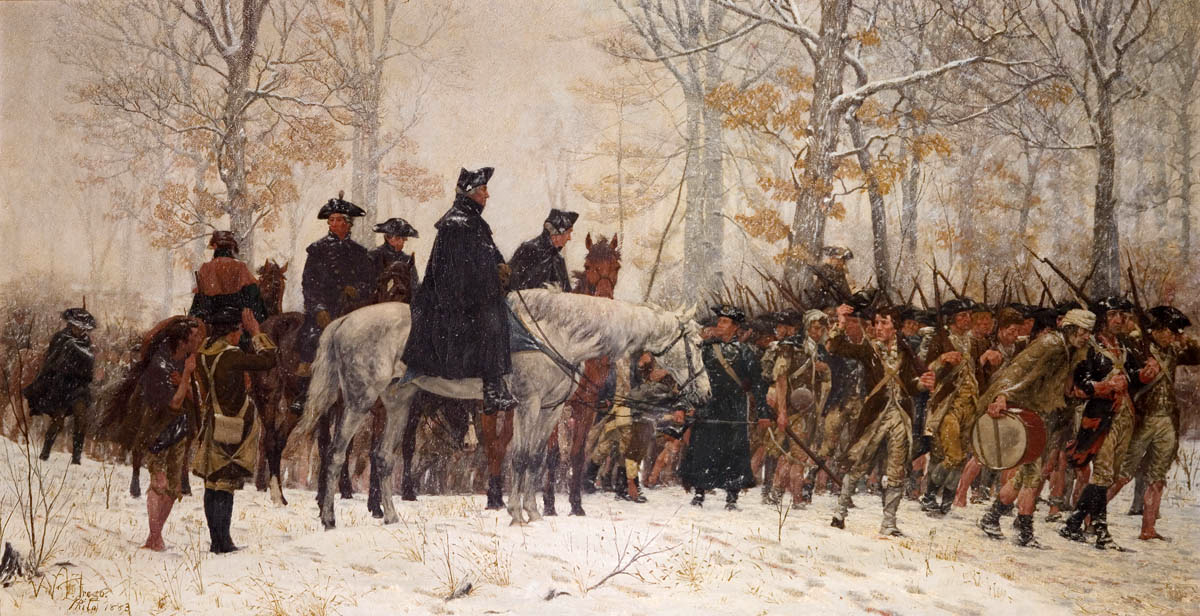
William B. T. Trego (1858–1909), "March to Valley Forge," 1883. Oil on canvas. Museum of the American Revolution, Philadelphia. Depicted is General George Washington leading the Continental Army to their winter encampment at Valley Forge in December 1777 — the same winter that Lieutenant Edward Spear and his fellow soldiers of the 6th Pennsylvania Regiment endured alongside their commander.
Sources:
Lytle, Richard M. The Soldiers of America's First Army, 1791. Lanham, Maryland: Scarecrow Press, 2004.
Trussell, John B.B., Jr. The Pennsylvania Line: Regimental Organization and Operations, 1776–1783. Harrisburg: Pennsylvania Historical and Museum Commission, 1977.
St. Clair's Defeat. Public Library of Fort Wayne and Allen County. Project Gutenberg. https://www.gutenberg.org/files/64870/64870-h/64870-h.htm.
Trego, William B. T. March to Valley Forge. 1883. Oil on canvas. Museum of the American Revolution, Philadelphia, Pennsylvania. Public domain. Wikimedia Commons.